Showing posts with label Polar Marines. Show all posts

15 January 2021

Passing it Down

While trying to get an outline together for my book (maybe one day it will be a book) Devil Dogs in Any Clime and Place: Marines in Polar Exploration 1840-1956, I had to decide which Marines, and which expeditions/operation to include/exclude, particularly those of the 20th century.  Some were too limited (in scope or participation) and yet they seemed to beg to be included.  Should I just do the Byrd expeditions to the South Pole? Should I include every single one? I decided to step back and look at it from afar for a bit to help me decide.

As a Marine historian for 19 years, I learned quickly that one of the hallmarks of the Corps is the tradition and practice of "passing it down."
Maj Jack Elliott USMC (Ret) (93 y.o.) handed cake to 1stLt Dupree (24 y.o.) during History Division's 2017 USMC birthday cake ceremony

Whether it be a piece of birthday cake from the oldest Marine to the youngest, or traditions from the Sergeant Major to the Private, it is a fine example of passing on what you've learned.

With this in mind, I realized (as I looked from afar), there was a pattern that could guide me to deciding what expeditions/operations/Marines to include/exclude.  It was there, all the time, repeating itself.  The Marines themselves!


The chart above demonstrates that from Byrd's expedition to fly over the North Pole in 1926, to Operation DEEP FREEZE I in 1956, there was at least one Marine connecting each operation/expedition in between the two.  As you can see, there is a clear connection between these two operations, 30 years apart.  The "repeat customer" award goes to Boyd, who participated in at least 6 expeditions to both poles, followed by Green with three trips. 
 
I'm still digging, still doing research and know that several of the Marines of the earlier Byrd expeditions remained in touch with one another and with Byrd until his death.  However, I have yet to find any documents demonstrating that they passed their experiences on to their fellow Marines; time will tell.  I'm sure there were stories told as they floated their way south to Antarctica in 1928, or north during Operation NANOOK. But, alas, no smoking gun in the form of a letter or diary entry--yet.

What I am finding out about the Marines who participated in these operations is something that I found out about the earliest Marine aviators that I researched years ago.  It's something that makes them great Marines.  They each have the willingness to go into dangerous situations, often they are adventure seekers--today we might even call them adrenaline junkies.  Some are rascals, scamps, mischievous.  The overwhelming majority of them are career Marines who retire.  There is only one who, so far, seems to have received the "Big Chicken Dinner" and told (using Jack Elliott's phrasing) "out bum!"

I plan to compile statistical information on the entire list and include it in my concluding chapter.  Officers? Enlisted? Mustangs? Retirees? MOS? and the like.  It is already proving quite interesting and I'm not done going through the records--there are more than 150 Marines thus far, and going through the muster rolls one by one is slow.  But in COVID times, it's not like I can go to NARA.

Back to my point about passing it down...

Since 1798, one Marine has always passed down what they've learned to the next.  Often is it is valuable and sage advice, sometimes it is bad habits and poor examples of 'leadership.'  However, there is no refuting that it is in the fabric of the Marine Corps to do this and even with the faults, one that I (as a historian) am quite fond of and like the most.


02 January 2021

Research during COVID

In May 2019, I started down the road of looking into five Marines who served in two of Richard E Byrd's Antarctic expeditions (1928-1930 and 1933-1935).  In the summer of that year, I ceased work on it for reasons unimportant to this discussion. 

But earlier this year, I decided those reasons that stopped me were no longer valid and I picked up where I left off and it has exploded, just in time for COVID-19 to really kick us all in the "jimmies" and bring things to a halt--or so I thought.  Research in COVID-times... 

Since I've had plenty of time on my hands in my off-hours, I've been doing research--99.5% of the research was done online or remotely via email.  Ancestry.com, Fold3.com, Proquest, random blogs and websites, newspapers.com, and online memorials have all been a treasure trove of information on individual Marines.  Online book sellers have made a killing off me these past 6 months, but in the end I will have a nice collection to donate to a repository one day.  Some of the books are signed first editions, others are signed by actual participants.

Ohio State's Byrd Polar and Climate Research Center Archival Program is my "go-to" online resource.  Every time a new name was found, I cross checked it against their online database.  While they don't have everything online, there is plenty there to keep me coming back for more, and to get me excited to visit when life comes back to some semblance of normalcy.  

The major hold up on research is the closure of the National Archives (College Park and St Louis) and the less than stellar search engine of digitized materials--however, I will give them kudos for getting more out there.  They simply have so much that they won't be getting to the goodies I want any time soon. 

Marines at South Pole (Pitman Papers USMC HD)

A note on a couple useful online tools, if you'll indulge me.  First is Google.  Google's drive function, online office products and email has allowed me to put these materials in a safe place and to use an email that isn't tied to my personal stuff.  Oh I know there are plenty of similar tools out there, but I already knew how to use google and all it's gadgets and it has been a Godsend.  I have it already on my phone, and just put the app on my tablet, so now I don't have to drag my laptop everywhere.

Rocketbook is the next--anyone who is like me and loves to keep notes in notebooks, knows that they stack up after a while and you run the risk of losing them and unless you want to carry them everywhere (all of them) you're kind of stuck when you travel.  Rocketbook is basically a dry-erase notebook (with multiple pages) you write in, then using their app, digitize your notes.  I save mine back to the aforementioned Google drive and boom, wipe the book and move on.

Pocket is a feature that I didn't realize was in my Firefox browser--but it is! One click and I've saved a website to Pocket.  Why not just bookmark it? Well, again, if I don't have my laptop with me, I can just pull up the app on what ever device I'm using and there are all my bookmarks.  And frankly, not digging through bookmarks (open your app and search) is really nice.

Yes, there are plenty of other tools out there to keep you organized, but these are a few that I'm using that are making my life a little bit better and helping me keep my research organized.  

I'm game to hear what others have been able to do while in COVID-times--what tools are you using? What resources have you found online (surprisingly or not so surprisingly) and what are some of the difficulties you've overcome? Tell me! I want to hear!

The result of my research so far? No longer is it just five Marines and Byrd in two Antarctic expeditions, today it is over 120 Marines (another found just today) over in 10 expeditions to both poles!  There are some interesting finds in amongst this story of Marines involved in polar exploration, but guess you'll have to wait for me to write the bloody book!

12 December 2020

Second Chances

In today's military, and most especially those of the enlisted ranks, second chances are few and far between.  I'm thinking of a particular case close to me, but will not speak of names at the moment.  Suffice it to say, a screw up that occurred while the enlisted person was very junior (and at least a decade has passed by) has succeeded in stunting a promising career--one where the person learned from their mistake, made the appropriate repentance, and has gone on to become a good leader of others.  However, because of this early career mistake, any further advancement is sadly impossible.  One would argue that the second chance was being allowed to reenlist and serve long enough to retire; however, what more could be learned from this person had they been allowed to move forward having seen the error of their way, and what damage has been done by disallowing this?

I was reminded of this person while digging through my list of Polar Marines again.  Marine X (names withheld again) enlisted on 31 July 1928 and went through the recruit depot at Parris Island.  When recruit training was complete, Marine X went to the 87th Company, Signal Battalion at Quantico where he attended Radio School.

Just four months later, Marine X was enroute to China to serve with the American Legation in Peking; while there he was assigned as a student operator at the radio station.    In September 1930 he was sent to Cavite to attend the radio school there, and the it was back to China to serve until December 1931.

Once back in the US, Private X was assigned to the 2d Signal Company at San Diego.  And in May 1932, we see a very short entry in the muster rolls.  

Unfortunately, the entry doesn't give any specifics and the previous month muster roll doesn't have any clues either.  However, a pattern begins here in May 1932.  No punishment it seems, but this will be the last time that forgiveness occurs.

In June he is transferred to Aircraft Squadrons, West Coast Expeditionary Forces in San Diego; he's assigned to air-ground instruction, which I suspect is radio communication between aircraft and ground forces.  On 1 August 1932, Private X reenlists.  

In October 1932, Private X is reassigned to VJ-7M (Marine Utility Squadron 7) as radio operator and plane mechanic.  Through the middle years of the 1930s, Private X serves with VS-15M (Marine Service Squadron 15) on the USS Lexington.  On 26 July 1934, he is promoted to Corporal and served in August begins being allowed to fly (even though he's not rated as a Naval Aviation Pilot).

While serving with VB-4M (Marine Bombing Squadron 4) at San Diego, his enlistment expires and his is discharged, and awarded the Good Conduct Medal with bar.  Eight years of service marred only slightly in 1932, and therefore Corporal X is reenlisted on 6 August, and promoted to Sergeant.  However, just weeks later, he goes AOL (absent over leave) for three days and is busted.

While he's busted, he does not lose his newly received Sergeant stripes, and goes on to serve with VB-4M (redesignated VMB-2 in July 1937) until another hiccup in February 1939.  This time he was AWOL (absent without leave) for three days and thus the consequences were stiffer.  

The loss of a stripe, and back to Corporal sounds as thought it would be sufficient to stymie any future issues.  However, this wouldn't be as interesting if it ended here.

On the first of March (yes, just the next month), Corporal X was transferred to Headquarters and Service Squadron 2, 2d Marine Aircraft Group, and just four days later he is AWOL once again.  This time, four days lapsed before he returned.

This time, the court martial sentenced him to the "Big Chicken Dinner" and he was confined in the brig through the rest of the month (PAL=prisoner at large).  In the next month, we find out his fate.

It seems while serving confinement, the bad conduct discharge was remitted by the Secretary of the Navy under the condition that Cpl X maintain a satisfactory record for six months. (name redacted)

I started wondering if Cpl X was going to be able to serve six months without another hiccup, but I already knew he served until 1946 (at the least) because of his name on the polar expeditions, so he must have done something right.

15 January 1940 comes along and Cpl X is once again promoted to Sergeant, and on 6 August 1940 he is discharged with character as VG (very good), not the EX (excellent) that is normally seen but I'm surprised that it's not worse considering all that has transpired.  He reenlisted 10 days later and on 9 December 1940 his is promoted to Staff Sergeant.  

Anyone else seeing a pattern? For two days in January 1941, SSgt X goes AOL again!  Keeping count? That's 4 times in a span of nearly 12 years.  This time, SSgt X is tried and sentenced to a loss of pay for two months, but not a loss of rank or confinement, surprisingly.

By October 1941, we find our Marine assigned to Marine Aircraft Group 21 and sporting the rank of Technical Sergeant.  TSgt X continues to serve in San Diego through 1941 and into 1942.  On 25 October 1942 he is promoted to Master Technical Sergeant.  Does the pattern hold? I know you're wondering!

The January 1943 muster roll demonstrates that the pattern of behavior holds true.  Once again, loss of rank--back to Technical Sergeant he goes.  It's not long lived though, as by July 1943, his is promoted to Master Technical Sergeant once again, while serving with Marine Base Defense Air Group 43 at El Centro.

MTSgt X continues to serve and deploys to the Pacific in mid-1944 with MBDAG-45 (later MAG-45).  With the end of the war, he returns to El Centro and to MAG-35.  It is in October 1946 that his service with the polar expedition (as part of Fleet Air Wing 5) brings him to the crossroad of my attention.  By January 1947, while on the expedition, he is promoted to Master Sergeant.

In January 1948, MSgt X is assigned to VMR-152 (Marine Transport Squadron) where he finishes his career as a Marine; on 31 July he is transferred to the reserves for retirement after 20 years of colorful service.  


This brings me back to the point at the beginning; MSgt X has a record of being AWOL or AOL five times throughout his twenty years, but is allowed to continue to advance through the enlisted ranks (to the most senior rank possible at the time).  While he is admonished, and makes amends, he is not stifled from advancement, or held back from deploying when needed.  

One might argue that it is because it was wartime and all men were needed.  However, the personal case I mentioned earlier, was also during wartime (Afghanistan and Iraq), and yet, this enlisted man was stifled at every turn regardless of glowing reports from his superiors and who never stepped out of line again, rather he turned the leaf and is now a fine example of a good SNCO.  His career will end there at 20 years, and I guess one must be grateful for being allowed to retire, but what could have been achieved by this enlisted man, or what could have benefited those around him by his example?  We'll never know.

Second chances, instead of "zero tolerance", often are far better examples.  History is full of shining examples of those who overcame their own mistakes to achieve far loftier goals, but what of those who are stunted because of zero tolerance, and what about those who are unable to see that one can learn from their past and go on to bigger and better things?


22 November 2020

The Great Man Version of History--Not

 Ask any historian about their education in the practice of history and you will likely hear about the various schools or approach to the study of history (ie longue duree, social, political, etc), and there are the specific fields within each (don't get me started on having to read EP Thompson's The Making of the English Working Class while in grad school). 


For this post, I'm looking specifically at the field of military history and it's approach to history focusing on the "great man" aspect of writing biographical military history. 

Go to any book store and you're likely to find books on the "great men" of military history--Napoleon, George Washington, Ulysses Grant; drilling deeper in Marine Corps history you'll find books on Puller, Butler, Lejeune, etc.  

I've always been a proponent of the micro version of military history, small unit actions, the minutiae history that is overlooked (insignia for example) and individual Marines that generally don't have books about them.  It's these individual Marines that I believe are the backbone of the Corps.  I've been often heard saying, "You know the Latin root of Corps, right?"  One cannot have a Marine Corps without bodies.  I am NOT a "Great Man" historian.

As I've been compiling a list of Marines involved in the various polar expeditions and operations (1840-1956), I've come across some fascinating individuals, who collectively contributed to a very unique aspect of the Marine Corps' history.  

Some of these Marines I've already written about, Downey, but most haven't seen the light of day just yet; lots of work to do still.  But here's a run down of a few.  For those who served in the 20th century (no I'm not ignoring the 1840's Marines), most were veterans of World War II; some went on to serve in Korea as well, and only a very few have service in WWII, Korea and Vietnam.  Several are Mustangs--going from enlisted to commissioned officers via the warrant officer route.  At least three were cited for valor in combat with Silver Stars and Bronze Stars.  One was even a prisoner of war in Korea, survived and wrote a book about his experience.

Ferranto Book
Ferranto Book

One of the questions I'm attempting to answer is why each Marine was chosen for the duty, and their MOS history gives us the clues.  There were amphibian tractor and tank mechanics, electricians, construction engineers, shore party experts, combat correspondents, radio operators, pilots and aircraft mechanics.  Even with their useful MOS employed, their experiences are varied to include duty with the parachute Marines, Raiders, service as recruiters, ships detachments, and one that was one of the first Embassy Marines from the time just after the MOU between the USMC and State Department was signed in 1948.  One Marine was even a patent holder for his inventions.

 These Marines, at least the ones I've researched thus far (more than 60 on the list so far, so not quite done) demonstrate the cumulative effects of various backgrounds and experiences that came together to contribute to the successful polar expeditions and operations. 

Are the contributions of individual Marines, such as these, more important than the contributions of a single 'great man'?  I'm not arguing that those deemed "great" men of the Corps, Lejeune for instance, aren't 'great'.  Lejeune's impact on the history of the Corps cannot be overstated or overlooked; in fact I believe that Lejeune is an aberration in the collective history of the Corps simply because his impact was so significant that is unique unto itself.  I am arguing that the collective impact of all the individual Marine (man and woman) not deemed "great" is far more significant that the few 'great men' overall.  

Go back to my question regarding the root of the word corps.  The Marine Corps is a collection of bodies (male and female) and it is those bodies that combine to create the singular Corps of Marines.  It is the corps of individuals contributing their various skills and experiences that make the Corps' impactful history.  To demonstrate this, let's look at Lewis Puller.  For all of Chesty's Navy Crosses, how many have been awarded to other Marines for individual acts of bravery? Cumulatively these other Marines total far more than Chesty's five Navy Crosses. 

Meme from https://www.military.com/marine-corps/5-reasons-why-chesty-puller-marine-corps-legend.html

Don't get me wrong, five by one person is nothing to sneeze at, and I'm not trying to denigrate his acts, rather to demonstrate that the unknown Marines have contributed more as a whole than the one man with a colorful nickname.  

It is through the tales of these lesser known (or unknown) Marines that I choose to view the history of the Corps.   If it were possible to know every man and woman who served in the Marine Corps, good or bad, and to have information on each one for all to read, I would.   I guess this latest project is just my attempt to ensure that these Marines and their service is not overshadowed, let alone forgotten. 


(sorry for the funky formatting; I haven't yet figured out the issue or how to fix it)


14 November 2020

The People You Meet

 While on the hunt for more information on each of the (now) 60+ Marines who served in the various Polar expeditions through the 1940s and 1950s, I spent the morning looking at the service of Joseph J. Downey.  This is a lesson in research, the things you find, and the people you meet doing this type of work (be aware, a little long but plenty of pictures!)

First, let me tell you about Downey--I first find him as part of Operation NANOOK, in July 1946 as a Technical Sergeant.  My goal is to build a chronology of service so I can understand (maybe) why he was chosen for the operation -- what skills did he have that might have been useful? Or was he simply manpower.

To the muster rolls (via ancestry.com) I go.  Just plug his name in, date (Jul 1946) and see what else pops up.  As you can see, the page shows him as a Staff Sergeant in 1944--but not quite back far enough in time to really give you any info.

So, scroll down on the page and you find a much earlier date of 1937!

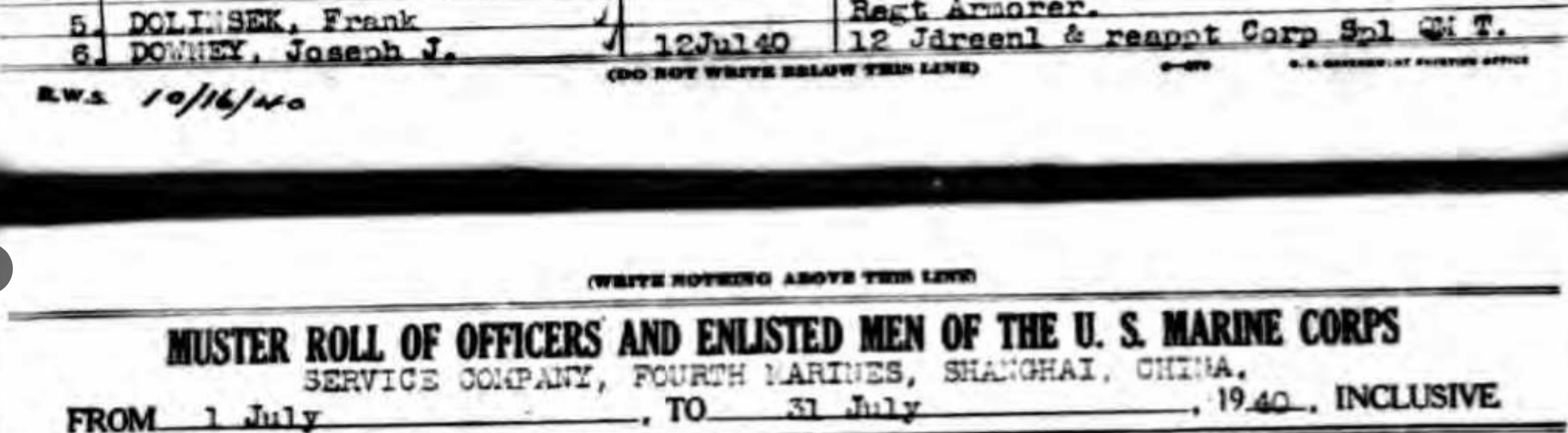
Now we're getting some where.  The list also shows an enlistment date of 12 July 1940, and with the Nov 1937 date, it's likely this 1940 is a reenlistment date.  A quick modification of the search parameters to 1940 vice 1946, and you find the July 1940 muster roll.  It confirms this IS a reenlistment date.

So at this point, Downey is in China with the 4th Marines!  He's a Corporal and in the QM.  But there's that 1937 date in there, let's go back and change the search parameters and see if we can get earlier.  Sure enough, we found a 1935 enlistment in the search results.

 
So again, changing the search parameters to give you 1935 results, we find that there are several entries for June 1935.  Just look at each one and see what you can find.  This time, the muster rolls shows another reenlistment--in Philadelphia.  Reviewing the other June 1935 results finds that Downey was discharged from the Fleet Marine Corps Reserve in order to join the Regular Marine Corps.

You keep repeating these steps until you find the initial date of enlistment.  In theory this should work.  Your only goal at this point is to find the initial entry into the Marine Corps; once you've done that, then you follow him forward month by month, year by year, unit by unit to build the chronology of service.  

I was doing pretty good, I had him back to 1935 and another search showed another enlistment date of 7 June 1934.  I thought I had him at his earliest enlistment date.  However, when narrowing the search parameters again, I found another Joseph J. Downey who enlisted in 1929.  But there was a gap between 1933 and 1934 in the search results.  This could be a quirk of ancestry or it could be two different Joseph J. Downey's.  It's not an uncommon name.  The 7 June 1934 entry states "joined by enlistment" and not reenlistment.  

Maybe it was two different Marines.  But there is only one way to find out, go to the 1929 enlistment and follow that Marine forward in time.  28 December 1929, the alternate Downey (Downey-A) enlisted at Parris Island; if he had enlisted in Philadelphia, it might have confirmed they were the same man.  However, forward we must go.

Downey-A goes on to serve at Quantico with the Maintenance Company of the 1st Regiment; while there he becomes an electrician (keep this in mind) and even some duty at Camp Rapidan (this is another story for another time).  Through his years of service, he ends up in San Diego, Puget Sound,  Pearl Harbor, and eventually Lakehurst where he's discharged on 27 September 1933 with "character excellent."

Still not sure if this is the same Downey, I start with the 7 June 1934 enlistment.  Downey-B enlists with 3d Battalion, 19th Reserve Regiment in Philadelphia.  Lakehurst and Philly aren't far apart, but still not really conclusive information if this is the same person.  Downey-B leaves the reserves in 1935 to joint the regulars and stays in Philly.  In May 1936, he's given temporary duty at Marine Barracks Lakehurst for duty "in connection with the landing of the airship HINDENBURG" which had crashed two days before.


I continue to follow Downey-B through his service; in October 1936 I got my first clue that these might be the same men.  Downey-B joined Marine Barracks Norfolk and his duty was listed as electrician!  Again, not concrete but still a possibility.

Keep following the muster rolls, Downey rises through the ranks, serves in China with the 4th Marines, returns to San Diego and joins the 2d Engineer Battalion, then the 18th Marines (Engineers) and then 2d Service Battalion.  He participates in Saipan, Tinian and Okinawa.  In October 1945, he's a Technical Sergeant stationed with the Service Battalion at Quantico.  Downey-B's service isn't over by a long shot.

For the next eight years, he participates in Operation NANOOK (where I first found him), serves in Guam, Yokosuka, Norfolk, and with 1st MAW in Korea before returning to the United States (MCAF Santa Ana) where he is discharged from active duty in July 1953, with a home address in Santa Ana (which I won't post but have down to the street level). His final rank was Master Sergeant, service number 225512.

I need more information to be sure these are the same Marine.  If he enlisted in 1929, I figure he's 18/19/20 years old.  So using ancestry to search with a birth year of 1911, I start trying to find the elusive Joseph J. Downey.  The California Death Index on Ancestry has a Joseph J. Downey who died in 1960 who lived in San Diego; date of birth listed as 10 Dec 1910.  This could be my guy, so using the exact dates, I narrow the search in ancestry. 


And the results are what I was hoping for--veterans gravesite information that matches some of what we know about Downey-B!

In the results is also a "findagrave" entry--sometimes these have photos of the headstones which can be very helpful confirming what we know.  This time, I was lucky--the headstone was photographed!

Master Sergeant Joseph John Downey (now I have a middle name!) and it does record WWII and Korea, which all matches.  Also in the search results are the internment control form, which is a HUGE BOON because it confirms the service number as 225612.  It's not a match to what I found, but that could be because I couldn't read the number clearly and wrote down what I saw--easily confirmed I was wrong and this IS Downey-B.  But how do we confirm if Downey-A and B are the same Marine?

In the search results is the Pennsylvania WWII Compensation Application.  Downey-B was from Pennsylvania so I click on it and begin reading it over.   Line 8 shows the service number of 225612, confirming Downey-B and just above it is the confirmation--Line 7 shows the date and place applicant entered active service--PARRIS ISLAND, 28 December 1929!  DOWNEY-A and B are the same Marine!

At this point, I have spent about 2 hours searching, guessing, theorizing, searching and finally victory.  It doesn't always happen this way.  Sometimes the names are just too common, or there's simply not enough information to go on.  

The internment control form stated that his widow was to be buried with him; therefore, I went back to the "findagrave" page and see that her name is highlighted--clicking it I see the photo of the reverse of Downey's headstone.  I smile at what I see.

CORPORAL Virginia M. Downey!  He married a fellow Marine! I was giddy--where did they meet? When did they marry? What's her maiden name? More searching on ancestry was required.  With the information I knew about Downey (middle name, date of birth and wife's first name), I searched the marriage records and found them!

They were married in DC! and there's her maiden name! Now I can... wait... what? Did they meet at Quantico!?  Did they serve in the same unit?!  Now, put her name in the muster roll search!!!

HUZZAH! Virginia enlisted 29 April 1944 in Pittsburgh, and after recruit training at Camp Lejeune, she was assigned to the Women's Reserve Battalion at Quantico with duty in the POST SERVICE BATTALION! They worked together in 1945!!!!  

Virginia served until sometime in 1946 and was discharged as a Corporal.  From her headstone, I see she died in 1999.  I found her obituary as well, she never remarried.  They were married for just under 11 years, and she never remarried.  It doesn't appear that they had any children as none are listed in the obituary.  

Research can lead you down many paths, but it can be very rewarding.  The places they went, the people they met and the things they did, are now once again relived--both of these Marines live again because of this exercise.  Maybe the few tips of my trade herein will help you in your research.  Ancestry's power grows with each day as they add more materials to their collection.  The only thing I have left to do with MSgt Downey is to obtain his Official Military Personnel File (OMPF) from the National Archives in St Louis (when they reopen) as it will fill in gaps in what I found in the muster rolls, confirm awards/decorations and tell me if he retired or not (can't tell from the muster rolls this time).  It will also confirm if he and Virginia had children.

Thanks for sticking it out with me on this one; I thought it might be helpful for you to see how I find what I do, and how analytical thinking and logic can play a role.

Master Sergeant Joseph John Downey and Corporal Virginia Marie Downey, you live again!