10 May 2021

Ever look on Heaven's scenes...

Another Marine reported for duty recently.  

This Marine wasn't one that I didn't know before, rather, my great uncle Bill (William N. Hoag) who I fondly remember from my childhood.

His memorial service was Saturday (8 May) and there was never any question about me making the trek north to make sure I was able to pay my last respects and tell him that his duty was done here, the rest of us would take the watch.  I got in around 0130 on Saturday morning, got a few hours sleep before starting the day.  

 The day was wet and dreary.  It was fitting for the mood of most in the funeral home.  The service was short and later we all crossed the street to gather at the church.  This is where the true service began, because the rain stopped, the sun peaked out, laughter filled the air and everyone ate too much.  It was just as Uncle Bill would have wanted.

Someone, I couldn't remember her name, asked me "What did you whisper to him at the funeral home?"  I didn't realize that I'd been spotted kneeling at the casket.  I smiled and said, "Only something a Marine would understand."  

Uncle Bill enlisted in the Corps on 16 September 1958 and was assigned to Platoon 199, 1st Recruit Training Battalion at Marine Corps Recruit Depot Parris Island. 

Because of the timing of his service, my super secret (not so secret) method of following his service through the muster rolls simply cannot be done.  However, I can tell you that he served at Cherry Point and Quantico, and spent nearly every free moment on the road home to NY where he was head over heels for a gal that happened to be my grandfather's youngest sister, and his future wife.  

Uncle Bill's life wasn't all about the Corps.  Like so many before him, and so many after him, he did his four years and  was discharged.  He returned home to Upstate New York, where he raised his family.  He drove truck, farmed, was a mechanic and a good father.  His youngest son was my age, so we often spent summers at Uncle Bill's and Aunt Bobbie's.  I remember him as a man with a warm heart, an easy smile and a laugh just waiting to bust forth.  

Unlike many of the Marines I've known or studied over the years, Uncle Bill didn't come home with a chest full of medals, didn't earn distinction in combat, nor did he remind you every waking moment that he was a Marine.  He simply did his duty, returned to home and made a good life for his family.  In my book, that's just as noble as all the ribbons and medals put together.  

I was one of the last to leave the church Saturday; knowing I had to be on the road back home the next morning, there was little time to do anything except get some rest.  But on the way home, the sun was nearly down, but it was a beautiful sky.  I stopped on on a back road that offered an outstanding view across the open fields and valley, and snapped a few images with my phone.  Maybe Uncle Bill painted this particular sunset for his family as a thank you for their love and tributes that day.  

"If the Army and the Navy
Ever look on Heaven's scenes,
They will find the streets are guarded
By United States Marines."

Rest in peace, Uncle Bill. 


24 April 2021

Legends and Lore in the Corps: Don't let the truth get in they way of a good story

 I've spent decades debunking myths, tracking down the origins of stories and verifying some tall tales that the Corps is known for.  Tonight, while scrolling through my Twitter feed, I stumbled into one about Steve McQueen, and Lee Marvin.  I thought it might be worthwhile to run my lips a little on the topic of legends and lore in the Corps.

When I was a historian with the Corps, I never actively debunked the myths.  If asked directly, I always gave the straight scoop.  Some were straight up lies, others had nuggets of truth, and some were no-kidding-straight facts.  When time allowed, I did what I did best, researched the rumors, myths and tall tales to try to sort fact from fiction.  I believed that even though they may not be true, the lore served a purpose; it was a way to bring Marines together.  

Smedley Butler, yeah, good ole Gimlet Eye himself.  I would have loved to have had the chance to meet him.  Everything I've read about the man, what he wrote, and what others have written about him, he sounds like a frickin' hoot. 

I recall the rumor that Butler had a tattoo of the Eagle, Globe and Anchor on his chest because he so loved the Marine Corps.  I'd seen this in many places, even in supposedly in his own words.  But the historian in me required documentary evidence.  A source that would dispel or prove the assertion for one and for all. What's more definitive than a Marine's official military personnel file (OMPF)?  Well, even this isn't concrete.


From BGen Butler's OMPF indicating "Marine Corps device tattoo"
 

As you can see, from his OMPF as a Brigadier, the "Marine Corps device tattoo" is recorded.  This seems to end the debate, Butler had the tattoo!  BUT...a few pages later, as a Major General, the tattoo is recorded differently.


From MajGen Butler's OMPF indicating "Tattoo American Eagle"

So, even the documentary evidence isn't enough to clear it up.  Either way, though, Butler had a tattoo on his chest and I'll believe that it is the Marine Corps emblem.  It adds to the mystic that is Smedley, it adds to his legend.  Further, for those Marines today who are hassled about tattoos, it gives them someone that is held in very high regard to point to in order to say, "Let's look at this policy a bit more."  These same Marines can also point to THE LEGEND, the Marine of all Marines--Lejeune--as well.  Yes folks, Lejeune was tattooed as well!

So let's circle back to Lee Marvin for a moment. 

Lee Marvin Headstone

You cannot argue that Lee Marvin exuded machismo; women wanted him and men wanted to be him--or so I've heard.  Lee Marvin was a Marine and WWII veteran.  The rumor long persisted that Lee Marvin told Johnny Carson that he'd been on Iwo Jima with Bob Keeshan ("Capt Kangaroo") and that he'd (Marvin) had been awarded the Navy Cross for bravery on the sulfur island.  Again, documentary evidence was required.  

Do a search online, can you find a Navy Cross citation for Lee Marvin? Not a transcription or anything, but a real copy of the citation? No.  The absence of evidence isn't evidence, but it can be used when combined with other evidence.  It is acknowledged that Marvin was wounded on Saipan in June 1944.  This can be easily verified by his casualty card (see below).


The card indicates he was ordered discharged on 12 July 1945.  While this isn't proof he wasn't on Iwo, it helps build the case.  If he were so wounded in June 1944 that he was ordered discharged in July 1945, it is unlikely he was on Iwo.  What about the muster rolls?

In January 1945, just one month before Iwo, Marvin is at the Transient Center in Hawaii, listed as "sk"--sick and foonote T is listed.  Footnote entry reads:


He's being transferred to the Depot of the Pacific in San Francisco in January.  He's not headed to Iwo Jima.  Strike three.  No, Lee Marvin did not fight on Iwo Jima and was not awarded the Navy Cross.  However, he did serve honorably, was wounded in action, and is buried in Arlington National Cemetery.

Had he been on Iwo and awarded the Navy Cross, would it change our impression of him? Not me.  He was a badass Marine, and a helluva an actor in my book.  Wouldn't change a thing! Oh, and Bob Keeshan? Yah, he was a Marine too!  But, he never left the US.  

Lastly, let's talk about Steve McQueen (or as he served under his full name Terrance S. McQueen).   There is a great story about him stealing an amtrac at Camp Pendleton, and then another story of him saving lives of Marines while on an exercise.  Like Lee Marvin, McQueen played some serious badass dudes on the screen, and it's not hard to think that maybe he was badass enough to steal an amtrac or save lives of his fellow Marines.

McQueen's OMPF was released and alas, the tale of joyriding in the amtrac is false.  


However, McQueen did participate in the cold weather exercise off the coast of Labrador.  He recounts the tale of saving the lives of his fellow Marines in a several articles.  One from 1960:
McQueen, and other Marines, did save the lives of their fellow Marines from the capsized amtrac in icy waters.  Pretty badass if you ask me.  

There are many other legends and tall tales that rear their heads now and again.  When the story seems too fantastic, or causes you to pause, do some homework.  Ask for proof, or dig it up yourself.  One of the best lessons I have learned in all my education, in all my years of 'on the job training' was to have a critical eye for things that just don't sound right.  Sometimes the tale doesn't pass the sniff test, and then sometimes you're surprised to find out it's true.   

If you think it sounds too good to be true, it might be.  If you think "really?" then dig into it.  Find those who know their stuff, read reliable sources, and find out for yourself.  

While I didn't actively seek to tell Marines that some of the tales they were told in boot camp were bunk, if they asked, I gave it to them straight.  I was often told that when I did tell them the stories that it was like kicking puppies.  On more than one occasion I heard, "You mean my DI lied to me?"  I would reply, "No.  It's not a lie if they didn't know the truth themselves."  On my very long list of "books to write before I die" is the "Enlisted Marine's History of the Corps" wherein enlisted Marines (and recruits, especially recruits) can read the unvarnished, real history of the Corps--where they will find "just the facts" and know that the history presented is not sugar coated, honest, and backed up by solid research.  One day.


15 April 2021

Always Women's History Month [Updated]

Lately, the Marines that have been finding me have come through from others who stumble upon them. No matter how they come to me, they are worthy of being remembered, they are making themselves known, and it is my job to tell their story.  Last month was Women's History Month, and because I was in the midst of moving, I didn't get the chance to tell you about this Marine that friend (and Marine) TG told me about. No matter, every month is a perfect month to talk about history.
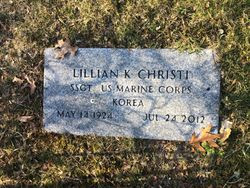
Courtesy of TG Heck


Lillian K. Christi was born on 14 May 1924 in Massachusetts, to Peter and Victoria Christi. She was born the same year as my grandfather, and like my grandfather (WWII veteran) she wanted to do her part in the war effort. But for her, it was the Korean War. Lillian enlisted in the Marine Corps at Boston on 28 January 1951. She joined the 3rd Recruit Training Battalion at Parris Island to train to be a Marine.

Extract from Muster Roll for January 1951, 3rd Recruit Training Battalion

On 16 April 1951, 70 years ago tomorrow, she was promoted to Private First Class and transferred to Service Battalion Camp Pendleton. Her MOS was listed as 0173 (staff office clerk). Lillian was promoted to Corporal on 4 December 1952, and just the next month she was promoted to Sergeant and six moths later she was promoted to Staff Sergeant. SSgt Christi's time in the Corps was short and seemingly uneventful; however, not everyone serves until retirement and leaves with a chestful of medals. Many more serve their time, do their duty and do it honorably. Such is the case of SSgt Christi. 

Her enlistment ended with an honorable discharge as SSgt on 24 January 1954. Her time in California made an impact, she lived there with her sister for many years before returning to the east coast. Staff Sergeant Christi lived a long life, passing away on 24 July 2012 at the age of 88. She did her part for our nation at a tough time, and for that we remember her. 

Thank you TG for introducing Staff Sergeant Christi to me so we could honor her service and bring her back to life once again. Staff Sergeant Christi, I know you would be so proud of your fellow ladies wearing the eagle, globe and anchor; they have done some wonderful things all the while struggling to deal with many of their fellow Marines who don't think they are "true Marines." Thank you, Staff Sergeant Christi, you are remembered!

19 April 2021

My daily walks take me by the cemetery in Manassas.  Today, I decided to walk through the rows.  It's quieter than the main drag and less cars. Sometimes I feel like I'm being called to walk the rows.  Today I wasn't the only one in the cemetery, so when I ran across the Marine, I didn't take a photo.  I didn't want to be rude to the person paying their respects nearby.  However, Corporal Cilley, wanted to be known.

Barbara Janet Cilley was born in Haverhill, Massachusetts.  The fact that she was born in the same state as Staff Sergeant Christi isn't the only similarity.  

Extract Eastern Procurement Division, October 1943

She enlisted on 20 October 1943 at Boston and then went to school at Camp Lejeune in January 1944.  By April she was assigned to Headquarters Marine Corps's Personnel Department and a Private First Class.  She was given the MOS of 055 (Clerk, General), which isn't surprising as many women filled admin billets such as these during World War II.  

I wonder if she celebrated the nation's birthday on 4 July 1944 or her promotion to Corporal? Both possibly.  I like to think so.  She stayed in until sometime after October 1945.  

She has a short memorial on Findagrave.  She sounds like the sweetest woman.  Cpl Cilley died in Florida on 18 June 2000. Like SSgt Christi, it appears she never married, but served in many capacities in her life.  Again, another woman who served without valor, but honorably and proudly enough to be remembered as a Marine in the afterlife.

Cpl Cilley, your service to our country is remembered once again.  Thank you.


06 April 2021

Forever a Private?

With the move completed, I can finally get back to research.  I'll forever have a soft spot for Marines of World War I, so when a Marine from today gave me the name of Charles Wolfhagel to me, I had to look into his service.  

Unlike today, many enlisted ranks were based on their billet and location.  Recruiting duty was one such type billet, where you could be a gunnery sergeant in city A, but if you wanted to transfer to city B and it only had Private billets, you could be reduced to private to transfer to the city.  Fred Stockham did this to stay in St Louis before World War I, and as we will see, so too did Wolfhagel.

Charles Wolfhagel, born in Paterson, New Jersey, on 15 June 1881.  He was still a teenager when his mother died, and his father died seven years later.  For a while he worked for his brother-in-law.  On 13 March 1905, Wolfhagel enlisted in the Marine Corps at Marine Barracks Brooklyn.  After a few months, he was transferred to Marine Barracks Narraganset Bay, Rhode Island, where he took up duty as the naval district commandant's orderly.

In June 1907, he transferred to the USS Virginia (BB-13) and spent the next two years on ships as part of the Marine detachments for the Virginia, Minnesota, and Wisconsin.  By March 1909, he was stationed at Marine Barracks Portsmouth (NH), where he ended his first enlistment as a Private.

Two years passed before Wolfhagel reenlisted.  On 9 March 1911, he reenlisted at Syracuse, New York, and was assigned duty as a recruiter in the city, then in Buffalo, and later Erie, Pennsylvania.  In October 1911, while in Buffalo, he was promoted to Corporal (recruiting warrant), and the following February he was promoted to Sergeant (RW).  As his promotion warrant was temporary, he was reduced to Private in March 1912, but the next month he was again a Corporal (RW).  In April 1912, he earned back his Sergeants stripes (RW), but August 1913 arrived and he was reduced to Private again, in order to transfer back to recruiting duty in Syracuse.

Wolfhagel transferred to Marine Barracks Washington Navy Yard in October 1913 and in the following April he joined the 46th Company which boarded the USS New York (BB-34), and all participated in the operations at Vera Cruz.  The company returned to the US and Wolfhagel joined the USS Washington (ACR-11) as part of its Marine detachment.  This too was short-lived, as he transferred to Marine Barracks Portsmouth (NH) once again, and discharged on 16 March 1915, as a Private.

At some point, Wolfhagel returned to Buffalo, where he reenlisted on 9 June 1915, and transferred to the 20th Company en route to Haiti.  While his service to this point had been classified as "excellent" and there were no reductions in rank due to poor performance, Wolfhagel was not immune to the whims of many Marines.  On 27 November 1915, while in Haiti, he went over leave.  What he didn't know until he returned on 1 December was that his promotion to Corporal had come through.  He was court-martialed and found guilty, but allowed to retain his rank on probation.

Extract of muster roll


Wolfhagel remained in Haiti, with periods of temporary duty in Cuba, until the United States entered the First World War.  On 25 January 1918, he received promotion to Sergeant (temporary warrant), and it became permanent in May.  In May, the 20th Company returned to the US and joined the 5th Regiment at Quantico, until it boarded the USS Henderson bound for France in June 1917.

On 1 August 1917, he was promoted to Gunnery Sergeant (TW), which he retained through the remainder of his service.  As part of the 5th Regiment, Wolfhagel participated in the Battle of Belleau Wood, where he was wounded and cited for bravery with the Silver Star citation (today's Silver Star Medal).  In July, the regiment once again was in battle, this time at Soissons.

As things quieted a bit in August, the Haitian Campaign Medal was delivered to Wolfhagel and others of the regiment who had served in Hispanola.  At the same time, he received the citation for bravery at Belleau Wood.

Blanc Mont isn't as well known a battle for Marines as Belleau Wood; however, the numbers of casualties exceeds the June battle.  The ferocity of the battle is often overlooked, but thankfully well covered by Pete Owen and John Swift in "A Hideous Price."    Wolfhagel suffered wounds during this battle, and lingered in the hospital until 14 November 1918 when he succumbed to them.

Today, Gunnery Sergeant Charles Wolfhagel rests peacefully at St. Mihiel American Cemetery.   I found Gunny Wolfhagel intriguing mostly because we had been in many of the same locations in our respective lifetimes.  As a native of Upstate NY (and one-time resident of Syracuse), and a historian serving at Quantico, we'd covered some of the same ground.  I even had the chance to walk the battlefields of Belleau Wood, and Blanc Mont.  One cannot walk the hallowed ground in France and not feel as if the ghosts of the past are walking with you; I know I certainly had the hairs go up on the back of my neck when in the wood and when overlooking Somme-py.

Thanks to TG Heck for bringing Wolfhagel to my attention with this fantastic photo from a memorial honoring World War I veterans in Ridgewood, New Jersey. 

Photo courtesy of TG Heck

Gunnery Sergeant Wolfhagel, thank you for your service.  You are remembered.


31 January 2021

History and Fandom

This isn't my typical blog posting, but bare with me.

So I have a cat named "Moose" and he is the current cat in my life in a long string of cats in my life.  I've had dogs and don't dislike them, but cats are just easier.  To be quite honest, they aren't as needy as dogs.  That says more about me than I'd like.  I digress. 

Moose showing me how to write

Because I enjoy cats, I enjoy people posting photos on social media of their cats (and dogs).  On twitter, somehow I came across an actor who has Maine Coon kitties, and enjoys posting their photos.  They are awesome and I was reminded how much I enjoy this actor.  First enjoyed watching him as Ritchie Valens, and most recently as Henry on "Longmire."  Yes, Lou Diamond Phillips.
Lou Diamond Phillips and kitties (from his Twitter)

I've liked his posts, and enjoyed seeing photos of his kitties and hearing about his latest projects (directing and acting). While I haven't started watching his latest show "Prodigal Son" (soon, I promise), the kitty photos keep me coming back.  I asked a question one day and his wife answered me AND he liked the tweets.  I was floored, and thrilled.  

I knew from my years as a Marine Corps historian that there was a tie between my work and this actor in the form of Master Gunnery Sergeant Leland "Lou" Diamond.  I don't know if the story is true about Mr. Phillips' dad knowing the Master Gunns, but I thought this would make a great way to talk about MGySgt Diamond and the character he was.

Have a few hashmarks!

Leland Diamond was born in Bedford, Ohio on 30 May 1890.  When the US joined the fight against Germany in April 1917, Leland soon left his job as a railroad switchman to enlist in the Marine Corps on 1August 1917.  Like many Marines, he went through bootcame at Paris (as it was spelled) Island in South Carolina.  In February 1918, he was a Corporal, embarked upon the USS Von Steuben bound for Brest, France.

On 11 June 1918, Diamond joined the 83d Company, 6th Regiment as a replacement.  The regiment was in the midst of the battle of Belleau Wood and needed the manpower. 

June 1918 Muster Roll 83d Company, 6th Regiment Extract

Diamond saw combat in every battle the Corps fought in during WWI: Chateau Thierry, Belleau Wood, Soissons, St. Mihiel and the Meuse Argonne.  He marched across the Rhine to occupy Germany after the armistice, and was promoted to Sergeant on 8 January 1919.

After occupation duty, he returned home to the US and was discharged at Quantico with excellent character with the rank of Sergeant.  

August 1919 Muster Roll 83d Company, 6th Regiment Extract

He returned to civilian life for two years, but apparently did not find the same satisfaction, so in September 1921, he reenlisted in the Marine Corps at Detroit, and was sent to Pensacola as a Private once again.

Promotions were rapid for him and while serving as Assistant Armorer at Parris Island in February 1925, he regained his sergeant's stripes.  In the summer of 1930, Diamond was sent to Shanghai to serve with 3d Battalion 4th Marines.  In September 1932, he was promoted to Gunnery Sergeant, and the next year he returned to the US proclaiming that China duty "wasn't much of a war."  Less than a year later, he returned to China with the same company, in the same battalion.

Diamond returned to the US again in January 1937, and eventually to duty with the 5th Marines as a platoon sergeant in the howitzer platoon.  On 10 July 1939, Diamond was with 2d Battalion 5th Marines at Quantico when he was promoted to Master Gunnery Sergeant.  

July 1939 Muster Roll 2d Battalion, 5th Marines Extract

Before America's entry into the Second World War, Diamond found himself and his battalion at Guantanamo Bay, Cuba for duty until early 1941 when it returned to New River, North Carolina (today's Camp Lejeune) until all hell broke loose at Pearl Harbor.  America joined the war and the 5th Marines found themselves headed across the Pacific to New Zealand to get ready for combat.  He had to fight for the chance to go to combat against those who thought he was too old.

 When the 1st Marine Division landed on Guadalcanal on 6 August 1942, Diamond was with them and his fellow 5th Marines comrades.  He was 52 years old.  Think about that for a moment.  He hadn't seen true combat since 1918 and here he was landing on the beaches of the south Pacific at 52 years old.  

His fame takes off from here.  Among the many fables concerning his "'Canal" service is the tale that he lobbed a mortar shell down the smoke stack of an off-shore Japanese cruiser.  It is considered a fact,
however, that he drove the cruiser from the bay with his harassing
near-misses.

Diamond did his duty and was commended for it by the Commanding General of the 1st Marine Division, who soon became Commandant.  LtGen Alexander A. Vandegrift wrote:


The 'Canal was Diamond's last combat.  He contracted malaria, and had kidney trouble in addition to two broken ribs.  He was sent back to New Zealand to regain his health.  He returned to his Marines in Australia, but did not see combat again.  

While combat wasn't in his future, it was in his past and he could use that knowledge to teach the newest Marines before they would go to the Pacific.  Diamond was transferred to recruit depot at Parris Island, where he started as a Marine, to instruct recruits.  He continued through the end of the war to train recruits, but his time had come.  Diamond was retired in November 1945.

Just six years later, Diamond was gone.  His legend lives on.  He may not be as recognizable as Chesty or Ole Gimlet Eye, but Lou Diamond was loved by his fellow Marines.  Usually sporting his goatee, he was easy to spot. 

Leland "Lou" Diamond beardless

His Marines knew he would teach them how to fight, keeping them in line and when not fighting, how to remain ready. 


Leland "Lou" Diamond, you're remembered once again thanks to my love of cats, and a certain movie star.  Go figure.  As I've said so many times, if they are remembered, they live on!


15 January 2021

Passing it Down

While trying to get an outline together for my book (maybe one day it will be a book) Devil Dogs in Any Clime and Place: Marines in Polar Exploration 1840-1956, I had to decide which Marines, and which expeditions/operation to include/exclude, particularly those of the 20th century.  Some were too limited (in scope or participation) and yet they seemed to beg to be included.  Should I just do the Byrd expeditions to the South Pole? Should I include every single one? I decided to step back and look at it from afar for a bit to help me decide.

As a Marine historian for 19 years, I learned quickly that one of the hallmarks of the Corps is the tradition and practice of "passing it down."
Maj Jack Elliott USMC (Ret) (93 y.o.) handed cake to 1stLt Dupree (24 y.o.) during History Division's 2017 USMC birthday cake ceremony

Whether it be a piece of birthday cake from the oldest Marine to the youngest, or traditions from the Sergeant Major to the Private, it is a fine example of passing on what you've learned.

With this in mind, I realized (as I looked from afar), there was a pattern that could guide me to deciding what expeditions/operations/Marines to include/exclude.  It was there, all the time, repeating itself.  The Marines themselves!


The chart above demonstrates that from Byrd's expedition to fly over the North Pole in 1926, to Operation DEEP FREEZE I in 1956, there was at least one Marine connecting each operation/expedition in between the two.  As you can see, there is a clear connection between these two operations, 30 years apart.  The "repeat customer" award goes to Boyd, who participated in at least 6 expeditions to both poles, followed by Green with three trips. 
 
I'm still digging, still doing research and know that several of the Marines of the earlier Byrd expeditions remained in touch with one another and with Byrd until his death.  However, I have yet to find any documents demonstrating that they passed their experiences on to their fellow Marines; time will tell.  I'm sure there were stories told as they floated their way south to Antarctica in 1928, or north during Operation NANOOK. But, alas, no smoking gun in the form of a letter or diary entry--yet.

What I am finding out about the Marines who participated in these operations is something that I found out about the earliest Marine aviators that I researched years ago.  It's something that makes them great Marines.  They each have the willingness to go into dangerous situations, often they are adventure seekers--today we might even call them adrenaline junkies.  Some are rascals, scamps, mischievous.  The overwhelming majority of them are career Marines who retire.  There is only one who, so far, seems to have received the "Big Chicken Dinner" and told (using Jack Elliott's phrasing) "out bum!"

I plan to compile statistical information on the entire list and include it in my concluding chapter.  Officers? Enlisted? Mustangs? Retirees? MOS? and the like.  It is already proving quite interesting and I'm not done going through the records--there are more than 150 Marines thus far, and going through the muster rolls one by one is slow.  But in COVID times, it's not like I can go to NARA.

Back to my point about passing it down...

Since 1798, one Marine has always passed down what they've learned to the next.  Often is it is valuable and sage advice, sometimes it is bad habits and poor examples of 'leadership.'  However, there is no refuting that it is in the fabric of the Marine Corps to do this and even with the faults, one that I (as a historian) am quite fond of and like the most.


02 January 2021

Research during COVID

In May 2019, I started down the road of looking into five Marines who served in two of Richard E Byrd's Antarctic expeditions (1928-1930 and 1933-1935).  In the summer of that year, I ceased work on it for reasons unimportant to this discussion. 

But earlier this year, I decided those reasons that stopped me were no longer valid and I picked up where I left off and it has exploded, just in time for COVID-19 to really kick us all in the "jimmies" and bring things to a halt--or so I thought.  Research in COVID-times... 

Since I've had plenty of time on my hands in my off-hours, I've been doing research--99.5% of the research was done online or remotely via email.  Ancestry.com, Fold3.com, Proquest, random blogs and websites, newspapers.com, and online memorials have all been a treasure trove of information on individual Marines.  Online book sellers have made a killing off me these past 6 months, but in the end I will have a nice collection to donate to a repository one day.  Some of the books are signed first editions, others are signed by actual participants.

Ohio State's Byrd Polar and Climate Research Center Archival Program is my "go-to" online resource.  Every time a new name was found, I cross checked it against their online database.  While they don't have everything online, there is plenty there to keep me coming back for more, and to get me excited to visit when life comes back to some semblance of normalcy.  

The major hold up on research is the closure of the National Archives (College Park and St Louis) and the less than stellar search engine of digitized materials--however, I will give them kudos for getting more out there.  They simply have so much that they won't be getting to the goodies I want any time soon. 

Marines at South Pole (Pitman Papers USMC HD)

A note on a couple useful online tools, if you'll indulge me.  First is Google.  Google's drive function, online office products and email has allowed me to put these materials in a safe place and to use an email that isn't tied to my personal stuff.  Oh I know there are plenty of similar tools out there, but I already knew how to use google and all it's gadgets and it has been a Godsend.  I have it already on my phone, and just put the app on my tablet, so now I don't have to drag my laptop everywhere.

Rocketbook is the next--anyone who is like me and loves to keep notes in notebooks, knows that they stack up after a while and you run the risk of losing them and unless you want to carry them everywhere (all of them) you're kind of stuck when you travel.  Rocketbook is basically a dry-erase notebook (with multiple pages) you write in, then using their app, digitize your notes.  I save mine back to the aforementioned Google drive and boom, wipe the book and move on.

Pocket is a feature that I didn't realize was in my Firefox browser--but it is! One click and I've saved a website to Pocket.  Why not just bookmark it? Well, again, if I don't have my laptop with me, I can just pull up the app on what ever device I'm using and there are all my bookmarks.  And frankly, not digging through bookmarks (open your app and search) is really nice.

Yes, there are plenty of other tools out there to keep you organized, but these are a few that I'm using that are making my life a little bit better and helping me keep my research organized.  

I'm game to hear what others have been able to do while in COVID-times--what tools are you using? What resources have you found online (surprisingly or not so surprisingly) and what are some of the difficulties you've overcome? Tell me! I want to hear!

The result of my research so far? No longer is it just five Marines and Byrd in two Antarctic expeditions, today it is over 120 Marines (another found just today) over in 10 expeditions to both poles!  There are some interesting finds in amongst this story of Marines involved in polar exploration, but guess you'll have to wait for me to write the bloody book!

22 December 2020

Leadership

 There's been a lot of talk about leadership of late; I see it on my twitter feed, in Facebook and in the news.  Good leadership seems to have taken a backseat to the terrible examples of bad leadership.   I thought I'd chime in with a few of my own observations.  I've been the minion, and in middle management, but I've also worked with the military long enough to have a pretty good perspective of leaders of all ranks, ages, sexes, makes and models.  

There are so many books that talk about leadership, what good leadership looks and acts like.  Yet, there are still many who do not get it.  Recent examples include an Army Sergeant Major getting the axe for "unprofessionalism"and just yesterday an Appeals Judge was nailed for creating a toxic work environment.  

One would think that the military would be a good place to create good leaders.  You could be forgiven for thinking that, but alas, it's not true.  The military creates terrible leaders, just the same as the civilian side of the workforce does.  As I'm a historian, let's take a look at some examples of leadership and see where this goes.  Hang on, could get bumpy. 


From the personal papers collection of Major General Paul Fontana, we find this gem.  While titled, "In a Nutshell," it really should be titled "Some Basic Leadership Skills."  Broken into three parts (Six Ways to Make People Like You, Twelve Ways of Winning People to You[sic] Way of Thinking and Nine Ways to Change People Without Giving Offense or Arousing Resentment" it really is sound advice for leaders.  

Thinking as an employee for a moment, I think of those I've had in leadership positions above me and how this was (or wasn't used).  Part 3, Rule 4 is the first one I learned.  I learned it from Paul and Christine Grisamore, owners of Grisamore Farms -- my first job.  I was never told what to do, rather asked to help, or to perform some task.  No matter what it was, it was always in the form of a question.  When I was in a leadership position, I tried to use this always when needing someone to do something (I wasn't always able, but I tried).  

Part 3, Rule 1: Begin with praise and honest appreciation.  When this is absent, respect goes right out the window.  Resentment fills in the void.  The lack of appreciation from your higher-ups is a sure fire way to turn a good employee into a free-loader.   This also goes hand-in-hand with the mantra "Praise in public, correct in private."  

Part 2, Rule 8: Try honestly to see things from the other person's point of view.  This is another form of respect; again, when omitted turns the person against you, and often will turn them into a non-communicator.  Why would they want to tell you anything if you're not even going to consider their point of view?  You don't have to agree with them in the end, but listen--honestly listen and try to understand where they are coming from.

Part 2, Rule 3:  If you are wrong, admit it quickly and emphatically.  This is huge!  The inability to (first) recognize you're wrong and (second) admit that you're wrong, is sheer and simple arrogance.  Your people will run from you quickly if you refuse to take this principle to heart.

 All parts and rules from Gen Fontana's list are applicable and wise for leaders to embrace.  I freely admit I was not aware of this list when I was in a leadership position, and could have used it.  I still have a great deal to learn.

So what about leadership lessons from two of the great leaders of the Corps? Lejeune? Butler?  Why not.  I created a presentation on their leadership stylings and it has been postponed, so why not tell you a little about what I picked up.


After years of studying these two and the history of the Corps, it's clear that Lejeune is the 'thinking' leader and Butler is the 'doing' leader.

During his career, Lejeune was assigned to a variety of posts and stations and encountered from many senior enlisted Marines--one such Marine was Sergeant Major John Quick.  By the time the two served together, Quick had already served 22 years, and Lejeune only a few more; however, Lejeune still took notice of Quick's interactions with his men. 


"A calm, forceful, intelligent, loyal and courageous man he was.  I never knew him to raise his voice, or use profane language, and yet he executed and obtained prompt and explicit obedience from all persons subject to his orders."  Maybe SgtMaj Quick had a list similar to that of Gen Fontana?

Butler, on the other hand, learned leadership under fire.  Butler's first duty as a Marine officer (a green one, and very young at that) was in the midst of the Spanish-American War, in Cuba.  His company commander was a 54 year old Captain Mancil Clay Goodrell, a veteran of the Civil War and a Marine for more than 20 years.  Goodrell took the young officer under his wing.  While no actual skirmishes or combat took place while Butler was in Cuba, he was occasionally subjected to sniper fire.  Demonstrating initiative, Butler asked Goodrell if he could join the Captain on his nightly inspections.  The request was approved.  During one of these nightly inspections, Goodrell strode ahead of Butler across open fields, seemingly indifferent to potential dangers.  Snipers began to fire at the two men.  Butler splayed himself on the ground, while Goodrell remained standing. 


"What the hell is the matter?" he snorted.  Goodrell demonstrated courage under fire and Butler soaked it up!  Years later, Butler noted that "whatever luck or skill I've had in the soldiering business I attribute to the teaching and example of that splendid officer."

Learning by example goes both ways--you can learn traits from good leaders, and as a leader, you must remember that others are watching and learning from your example--good or bad!

There are many traits of good leaders.  A great book one should pick up is The Servant Way: Leadership Principles from John A. Lejeune by Maurice Buford (or as I know him Chaplain Buford).  It really is quite fantastic.  Servant Leadership comes from Robert Greenleaf in the 1970s and much of what you see in Gen Fontana's list, is incorporated in the 10 Principles of Servant Leadership.

Regrettably, leadership courses aren't offered as a standard education; often it's left to on the job training, which doesn't always yield the best results.  In the Federal hiring system, newly minted leaders (supervisors, managers, directors, anyone with subordinates) are not required to attend leadership 101 courses, or "how to manage civilians" course.  I know, because I wasn't.  I also know that those who are hired into civilian positions are often former and retired military, and just because they wore the uniform does not mean they know anything about being a supervisor, especially a supervisor of civilians.  

Further, those in uniform, in leadership positions, may not have the skills needed to lead outside of combat.  Today's military is more than just "motivate them to fight."  One must also learn to manage, inspire, encourage, and build up your subordinates without screaming, belittling, disrespecting or creating a toxic environment.  However, these (thinking of the Sergeant Major mentioned at the front of this) folks often learned by example--they were screamed at, cussed out, threatened and disrespected and therefore think that is the proper way to motivate. 

Are there examples of positive leaders in your life? What did they do that really impacted you positively and drove you to do more than the bare minimum? I'd love to hear!


12 December 2020

Second Chances

In today's military, and most especially those of the enlisted ranks, second chances are few and far between.  I'm thinking of a particular case close to me, but will not speak of names at the moment.  Suffice it to say, a screw up that occurred while the enlisted person was very junior (and at least a decade has passed by) has succeeded in stunting a promising career--one where the person learned from their mistake, made the appropriate repentance, and has gone on to become a good leader of others.  However, because of this early career mistake, any further advancement is sadly impossible.  One would argue that the second chance was being allowed to reenlist and serve long enough to retire; however, what more could be learned from this person had they been allowed to move forward having seen the error of their way, and what damage has been done by disallowing this?

I was reminded of this person while digging through my list of Polar Marines again.  Marine X (names withheld again) enlisted on 31 July 1928 and went through the recruit depot at Parris Island.  When recruit training was complete, Marine X went to the 87th Company, Signal Battalion at Quantico where he attended Radio School.

Just four months later, Marine X was enroute to China to serve with the American Legation in Peking; while there he was assigned as a student operator at the radio station.    In September 1930 he was sent to Cavite to attend the radio school there, and the it was back to China to serve until December 1931.

Once back in the US, Private X was assigned to the 2d Signal Company at San Diego.  And in May 1932, we see a very short entry in the muster rolls.  

Unfortunately, the entry doesn't give any specifics and the previous month muster roll doesn't have any clues either.  However, a pattern begins here in May 1932.  No punishment it seems, but this will be the last time that forgiveness occurs.

In June he is transferred to Aircraft Squadrons, West Coast Expeditionary Forces in San Diego; he's assigned to air-ground instruction, which I suspect is radio communication between aircraft and ground forces.  On 1 August 1932, Private X reenlists.  

In October 1932, Private X is reassigned to VJ-7M (Marine Utility Squadron 7) as radio operator and plane mechanic.  Through the middle years of the 1930s, Private X serves with VS-15M (Marine Service Squadron 15) on the USS Lexington.  On 26 July 1934, he is promoted to Corporal and served in August begins being allowed to fly (even though he's not rated as a Naval Aviation Pilot).

While serving with VB-4M (Marine Bombing Squadron 4) at San Diego, his enlistment expires and his is discharged, and awarded the Good Conduct Medal with bar.  Eight years of service marred only slightly in 1932, and therefore Corporal X is reenlisted on 6 August, and promoted to Sergeant.  However, just weeks later, he goes AOL (absent over leave) for three days and is busted.

While he's busted, he does not lose his newly received Sergeant stripes, and goes on to serve with VB-4M (redesignated VMB-2 in July 1937) until another hiccup in February 1939.  This time he was AWOL (absent without leave) for three days and thus the consequences were stiffer.  

The loss of a stripe, and back to Corporal sounds as thought it would be sufficient to stymie any future issues.  However, this wouldn't be as interesting if it ended here.

On the first of March (yes, just the next month), Corporal X was transferred to Headquarters and Service Squadron 2, 2d Marine Aircraft Group, and just four days later he is AWOL once again.  This time, four days lapsed before he returned.

This time, the court martial sentenced him to the "Big Chicken Dinner" and he was confined in the brig through the rest of the month (PAL=prisoner at large).  In the next month, we find out his fate.

It seems while serving confinement, the bad conduct discharge was remitted by the Secretary of the Navy under the condition that Cpl X maintain a satisfactory record for six months. (name redacted)

I started wondering if Cpl X was going to be able to serve six months without another hiccup, but I already knew he served until 1946 (at the least) because of his name on the polar expeditions, so he must have done something right.

15 January 1940 comes along and Cpl X is once again promoted to Sergeant, and on 6 August 1940 he is discharged with character as VG (very good), not the EX (excellent) that is normally seen but I'm surprised that it's not worse considering all that has transpired.  He reenlisted 10 days later and on 9 December 1940 his is promoted to Staff Sergeant.  

Anyone else seeing a pattern? For two days in January 1941, SSgt X goes AOL again!  Keeping count? That's 4 times in a span of nearly 12 years.  This time, SSgt X is tried and sentenced to a loss of pay for two months, but not a loss of rank or confinement, surprisingly.

By October 1941, we find our Marine assigned to Marine Aircraft Group 21 and sporting the rank of Technical Sergeant.  TSgt X continues to serve in San Diego through 1941 and into 1942.  On 25 October 1942 he is promoted to Master Technical Sergeant.  Does the pattern hold? I know you're wondering!

The January 1943 muster roll demonstrates that the pattern of behavior holds true.  Once again, loss of rank--back to Technical Sergeant he goes.  It's not long lived though, as by July 1943, his is promoted to Master Technical Sergeant once again, while serving with Marine Base Defense Air Group 43 at El Centro.

MTSgt X continues to serve and deploys to the Pacific in mid-1944 with MBDAG-45 (later MAG-45).  With the end of the war, he returns to El Centro and to MAG-35.  It is in October 1946 that his service with the polar expedition (as part of Fleet Air Wing 5) brings him to the crossroad of my attention.  By January 1947, while on the expedition, he is promoted to Master Sergeant.

In January 1948, MSgt X is assigned to VMR-152 (Marine Transport Squadron) where he finishes his career as a Marine; on 31 July he is transferred to the reserves for retirement after 20 years of colorful service.  


This brings me back to the point at the beginning; MSgt X has a record of being AWOL or AOL five times throughout his twenty years, but is allowed to continue to advance through the enlisted ranks (to the most senior rank possible at the time).  While he is admonished, and makes amends, he is not stifled from advancement, or held back from deploying when needed.  

One might argue that it is because it was wartime and all men were needed.  However, the personal case I mentioned earlier, was also during wartime (Afghanistan and Iraq), and yet, this enlisted man was stifled at every turn regardless of glowing reports from his superiors and who never stepped out of line again, rather he turned the leaf and is now a fine example of a good SNCO.  His career will end there at 20 years, and I guess one must be grateful for being allowed to retire, but what could have been achieved by this enlisted man, or what could have benefited those around him by his example?  We'll never know.

Second chances, instead of "zero tolerance", often are far better examples.  History is full of shining examples of those who overcame their own mistakes to achieve far loftier goals, but what of those who are stunted because of zero tolerance, and what about those who are unable to see that one can learn from their past and go on to bigger and better things?


04 December 2020

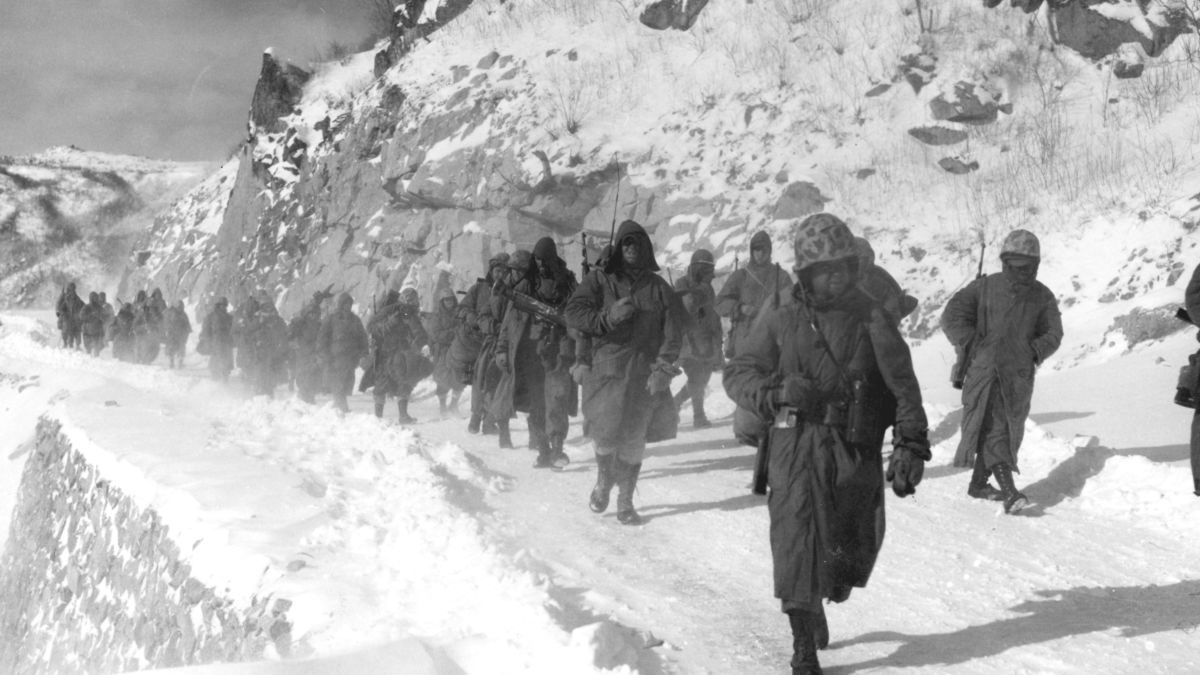
Changjin 70 Years Later

Because nothing I could say would ever be better than what has already been written, I am keeping this post brief.  Suffice it to say, this is in honor of those who fought, those who died, and those who have yet to come home from this battle 70 years later.


Many think of Changjin (Chosin) as a Marine only battle, where the Corps fought "in another direction" to get out of the frozen hell.  However, there were many members of the US Army fighting and dying right there with the Marines, and one must not forget the Bootnecks of 41 Commando (said as Four One, not forty one).  


If you're inclined to read more, might I suggest the following:

U.S. Marines at the Changjin Reservoir: Frozen Chosin

Nightmare at the Chosin Reservoir 

41 Commando/Task Force Drysdale at Chosin

If you really want to get down in the weeds of it, look at Vol III of the US Marines in Korea Series  

Now, for all those who didn't come home from Changjin, and are simply waiting for us to be able to get back there to find them.  We remember you; you are not forgotten.

 So, when you're feeling a little bumbed about some snow, or your dinner got cold because you were busy or you're bitching about having to stay in your warm house because of COVID, read some of the accounts of these men and remember, there are far worse things that you could be doing.